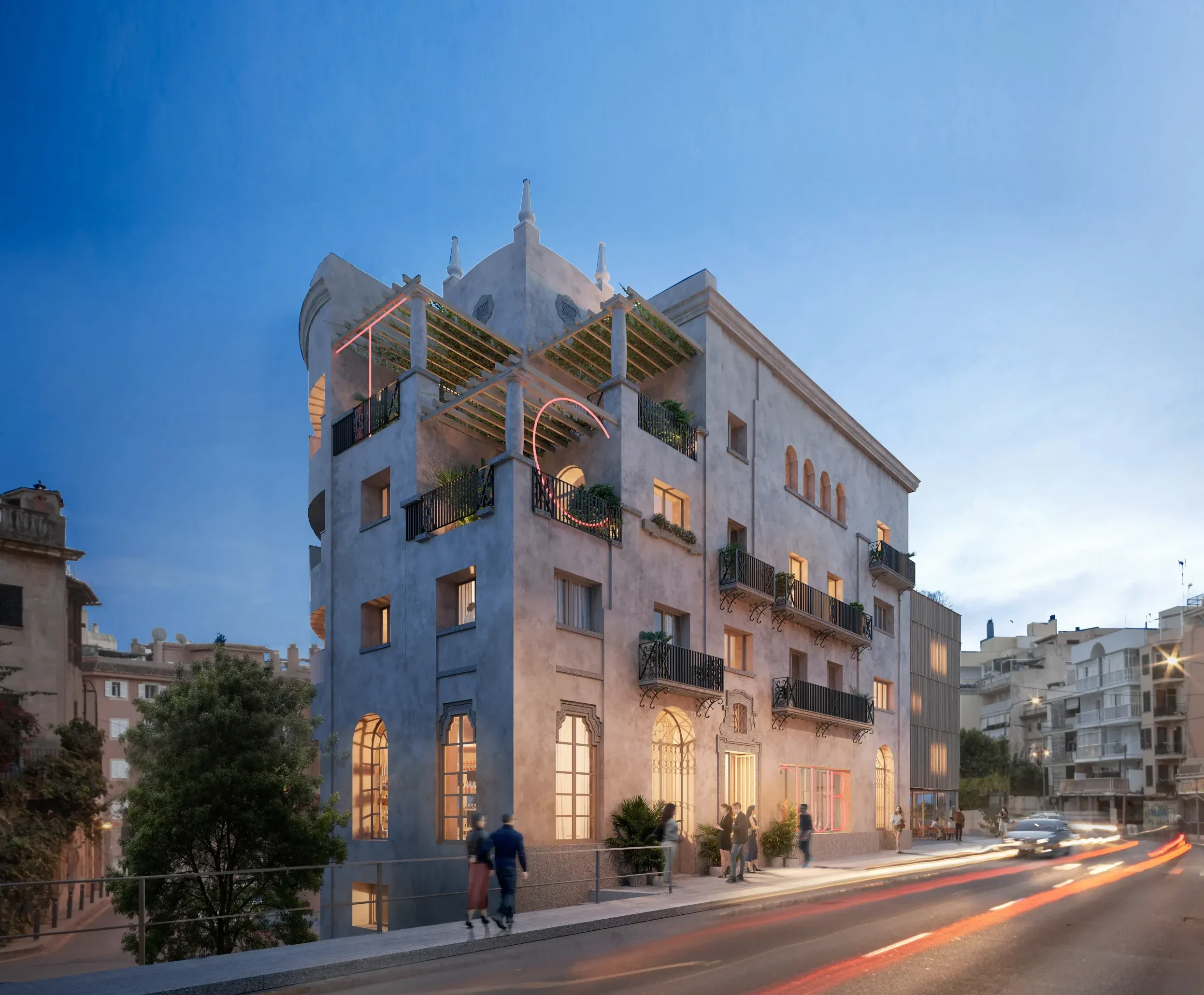
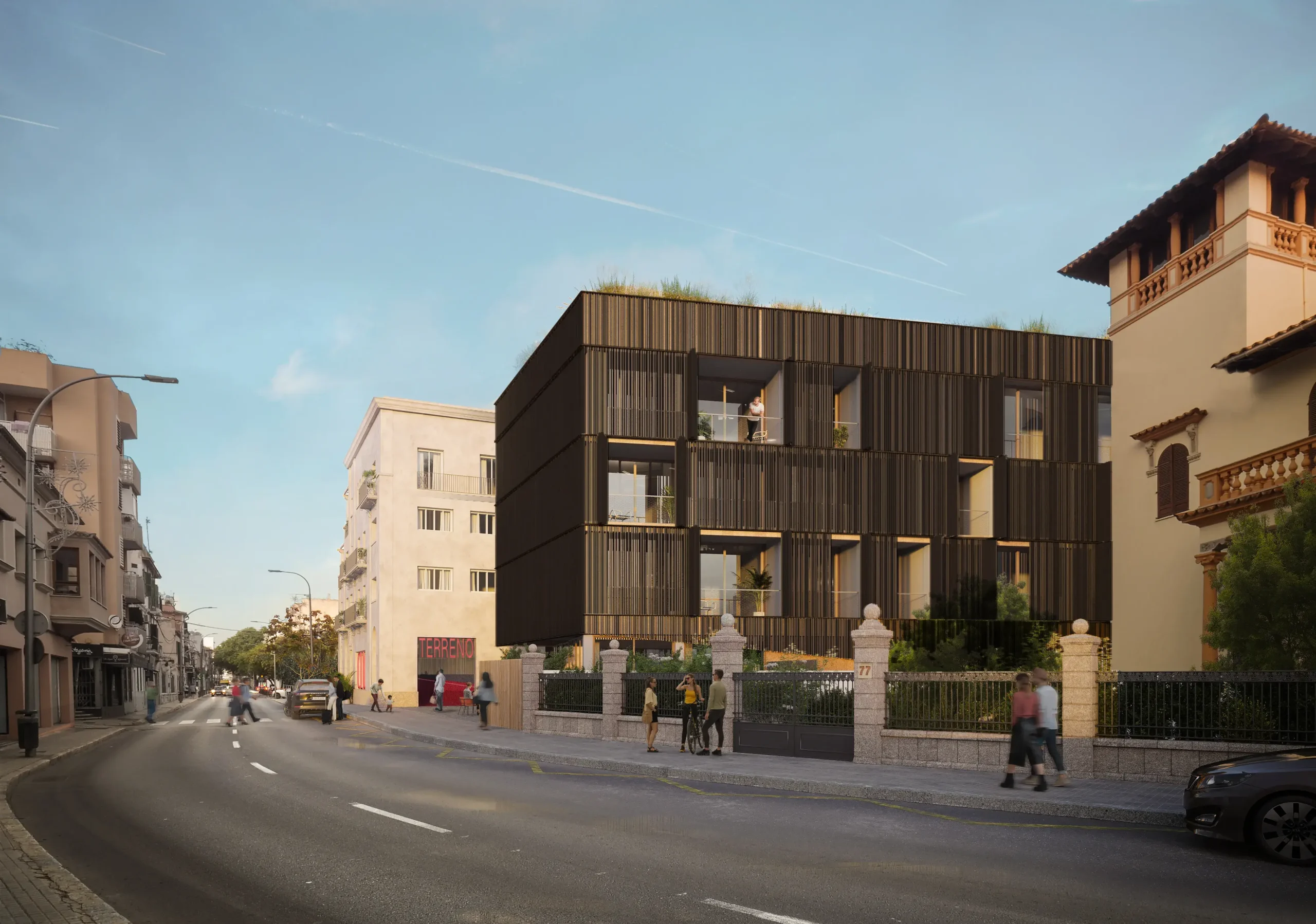
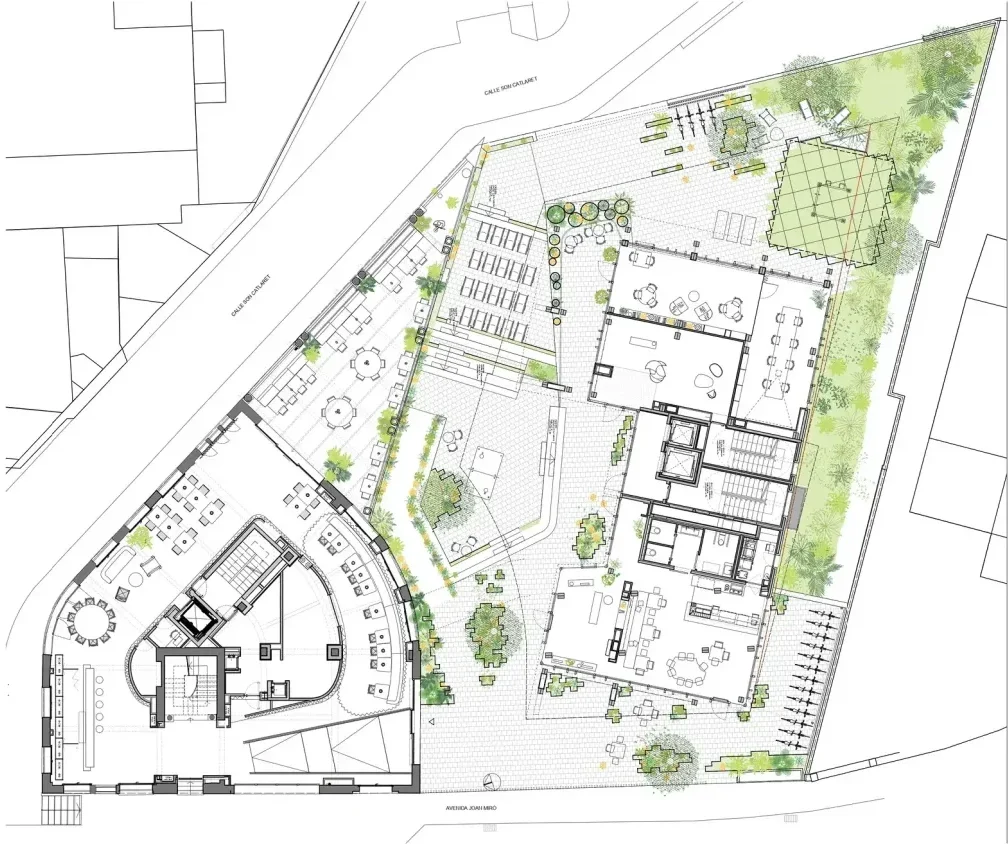
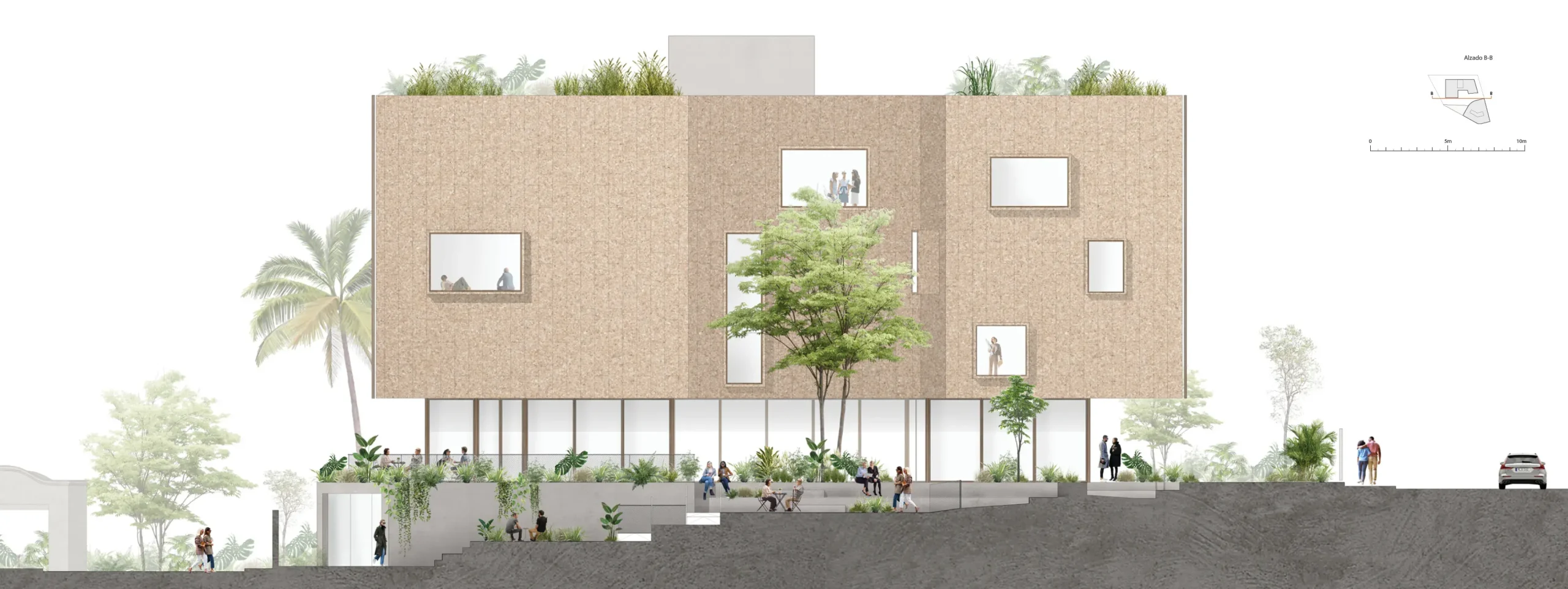
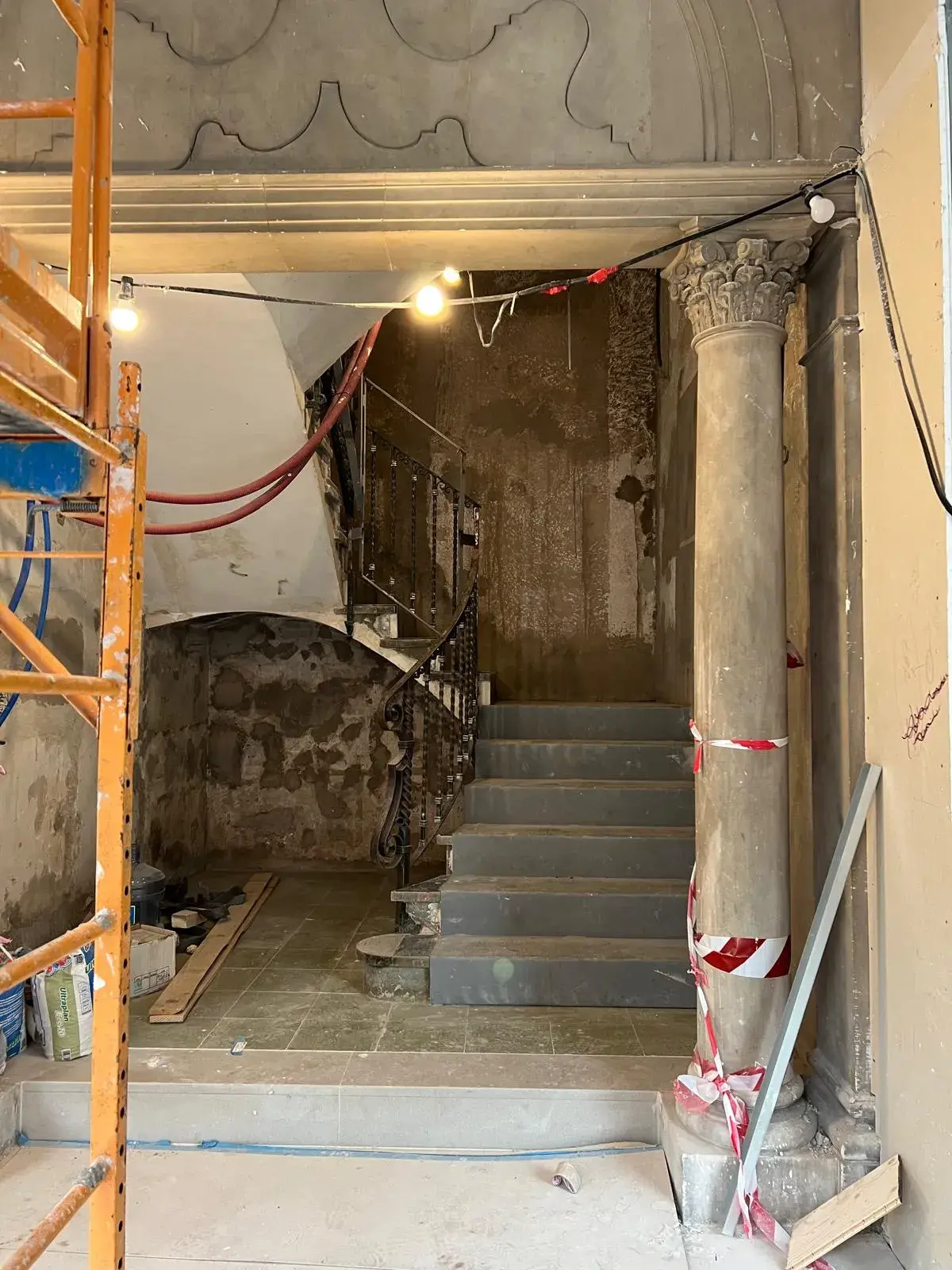
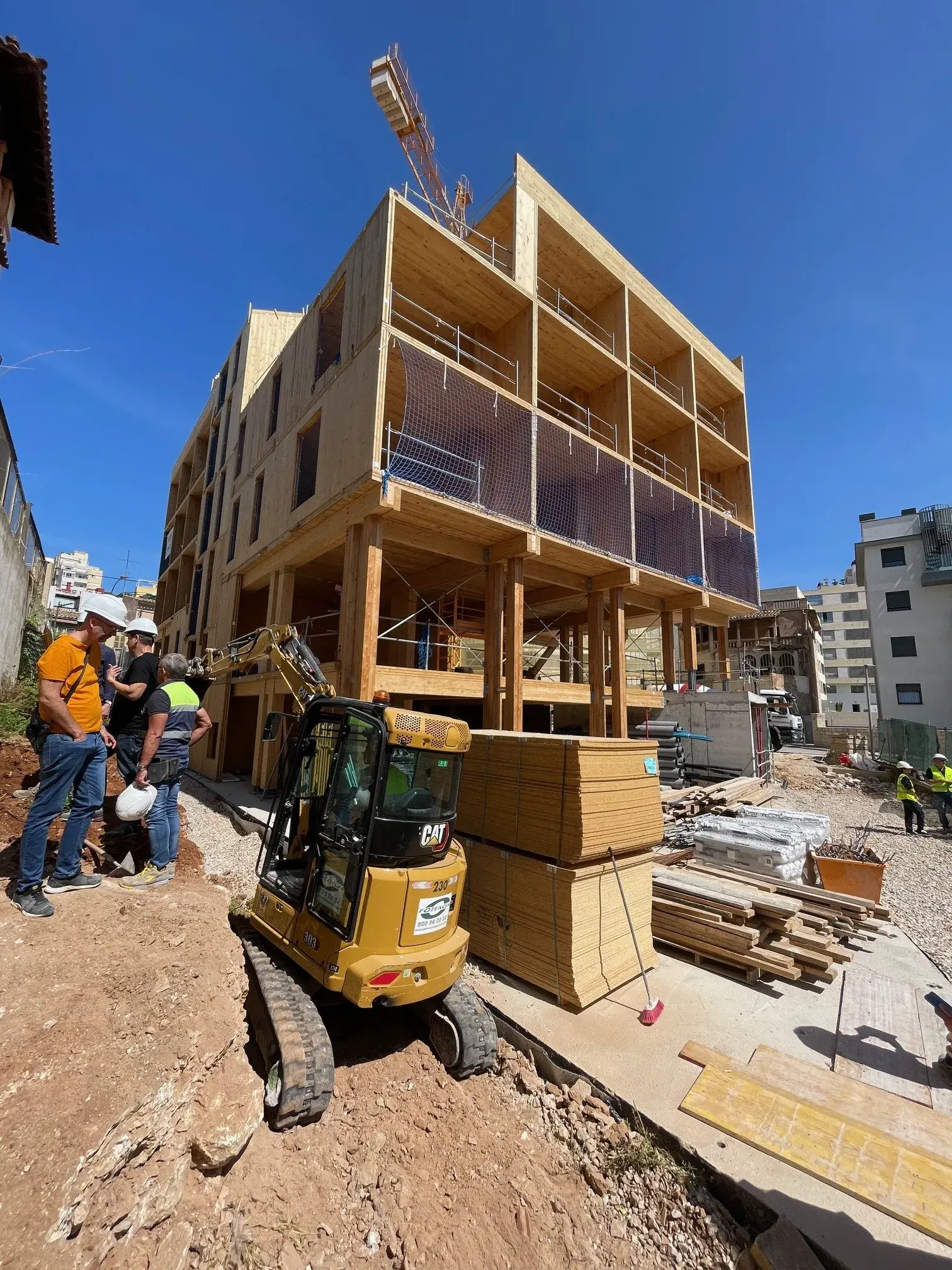
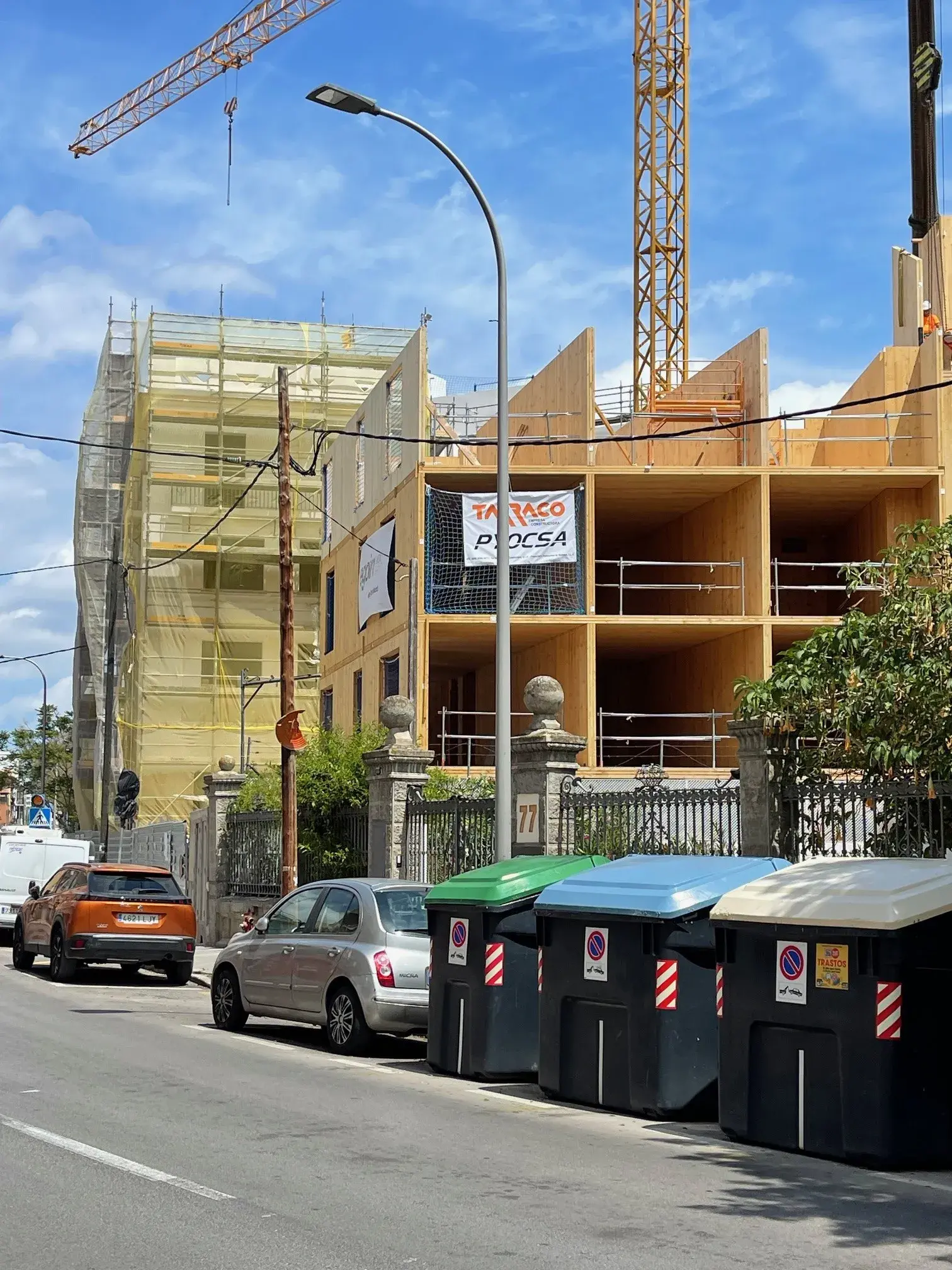
Terreno Barrio Hotel is a 41-room urban hotel in El Terreno, on Palma’s Joan Miró axis, shaped by an uncommon condition: two radically different pieces that depend on one another. On the one hand, a protected building from 1935 (Francesc Casas), an eclectic overlap of regionalism and rationalism, crossed by later structural interventions—crude, yet effective—that have become part of its biography. On the other, a vacant plot that enables a new seven-storey building conceived as a contemporary counterpoint: a CLT timber structure designed under strict Passive House criteria (not certified) and awarded LEED Platinum certification.
Terreno Barrio Hotel
Palma de Mallorca
Terreno Barrio Hotel is a 41-room urban hotel in El Terreno, on Palma’s Joan Miró axis, shaped by an uncommon condition: two radically different pieces that depend on one another. On the one hand, a protected building from 1935 (Francesc Casas), an eclectic overlap of regionalism and rationalism, crossed by later structural interventions—crude, yet effective—that have become part of its biography. On the other, a vacant plot that enables a new seven-storey building conceived as a contemporary counterpoint: a CLT timber structure designed under strict Passive House criteria (not certified) and awarded LEED Platinum certification.
From the outset, the project is framed as an urban and ethical stance: we want to give more back to the neighbourhood than we take from it. Terreno is not conceived as a tourist object imposed on its context, but as a device for exchange; a hotel that, before being a hotel, aims to be an extension of the barrio. This is not a slogan: it is the principle that orders programme, thresholds, atmospheres and materiality.
Architectural concept: bazaar + stage, connected by an alleyThe architecture operates as a small urban system composed of three conceptual parts:The bazaar: in the new building, the ground floor and the “contact levels” host uses conceived...
Architectural concept: bazaar + stage, connected by an alley
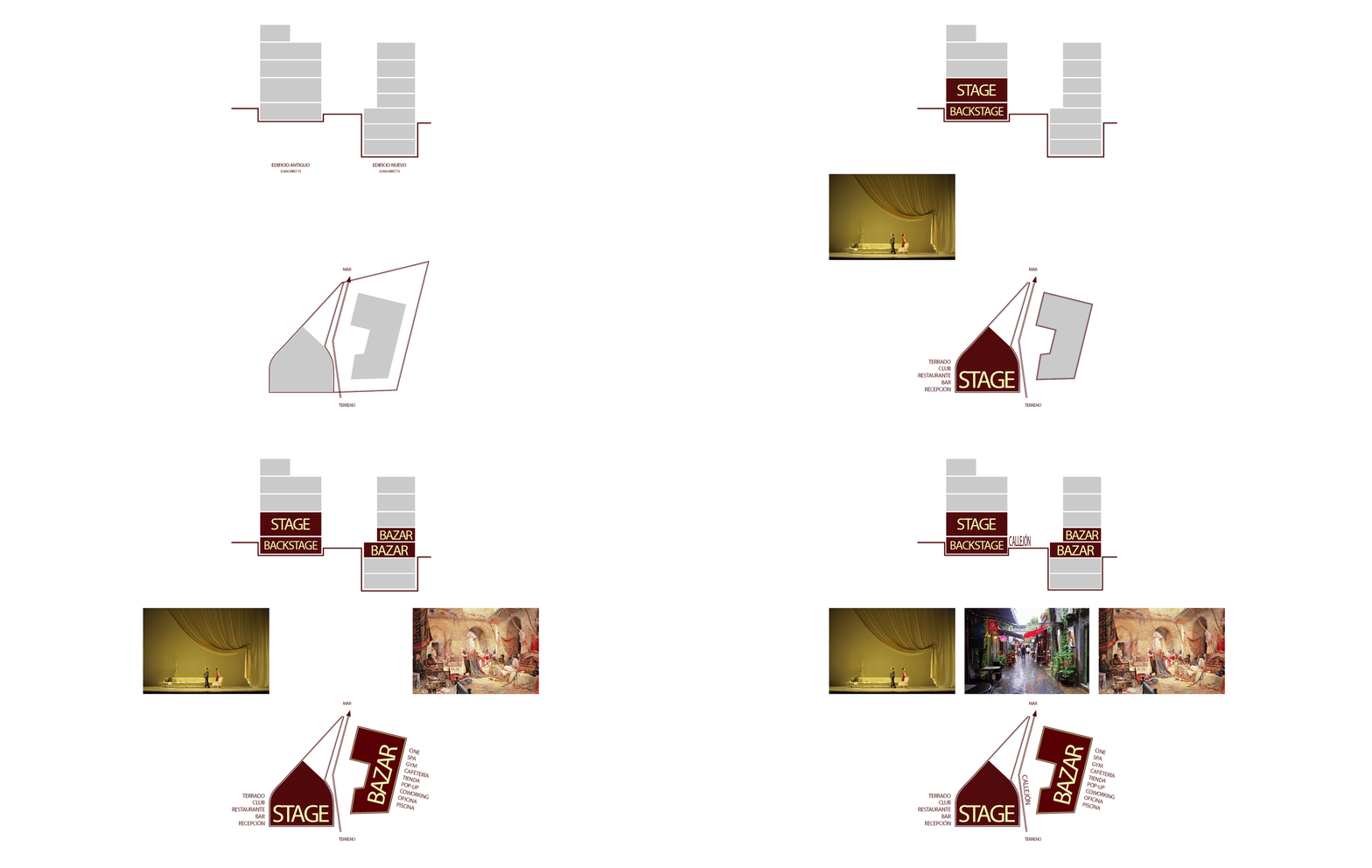
The architecture operates as a small urban system composed of three conceptual parts:
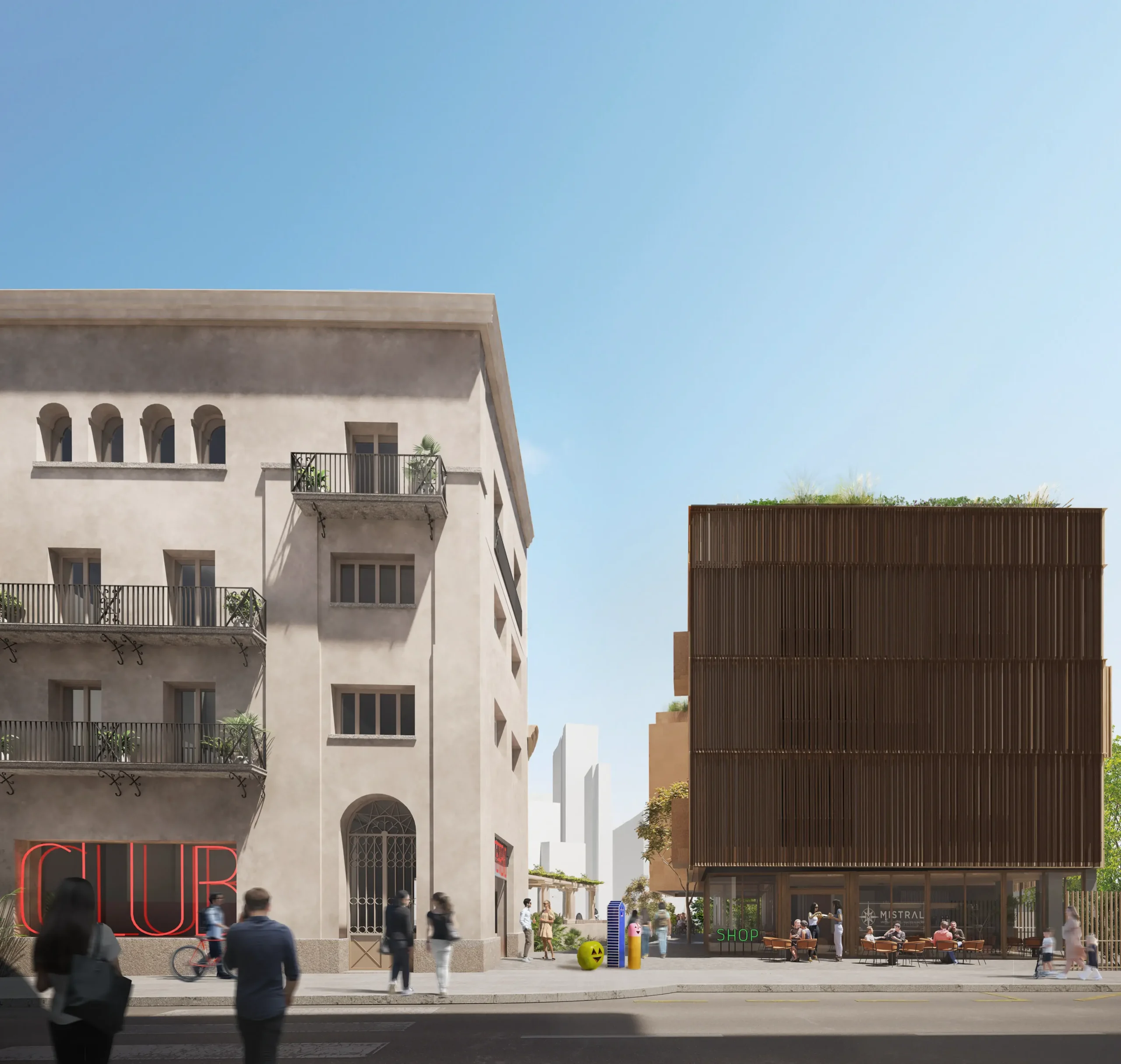
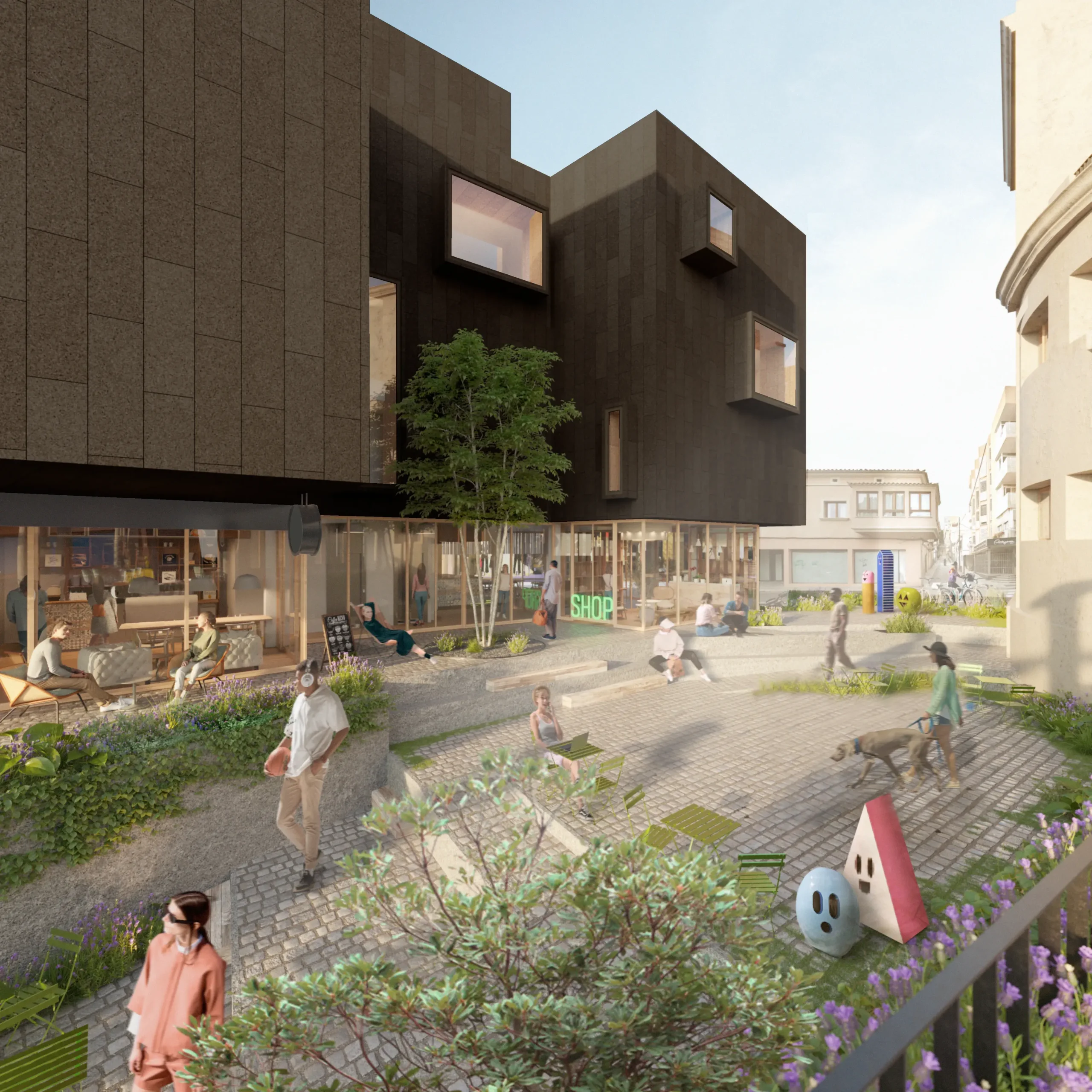
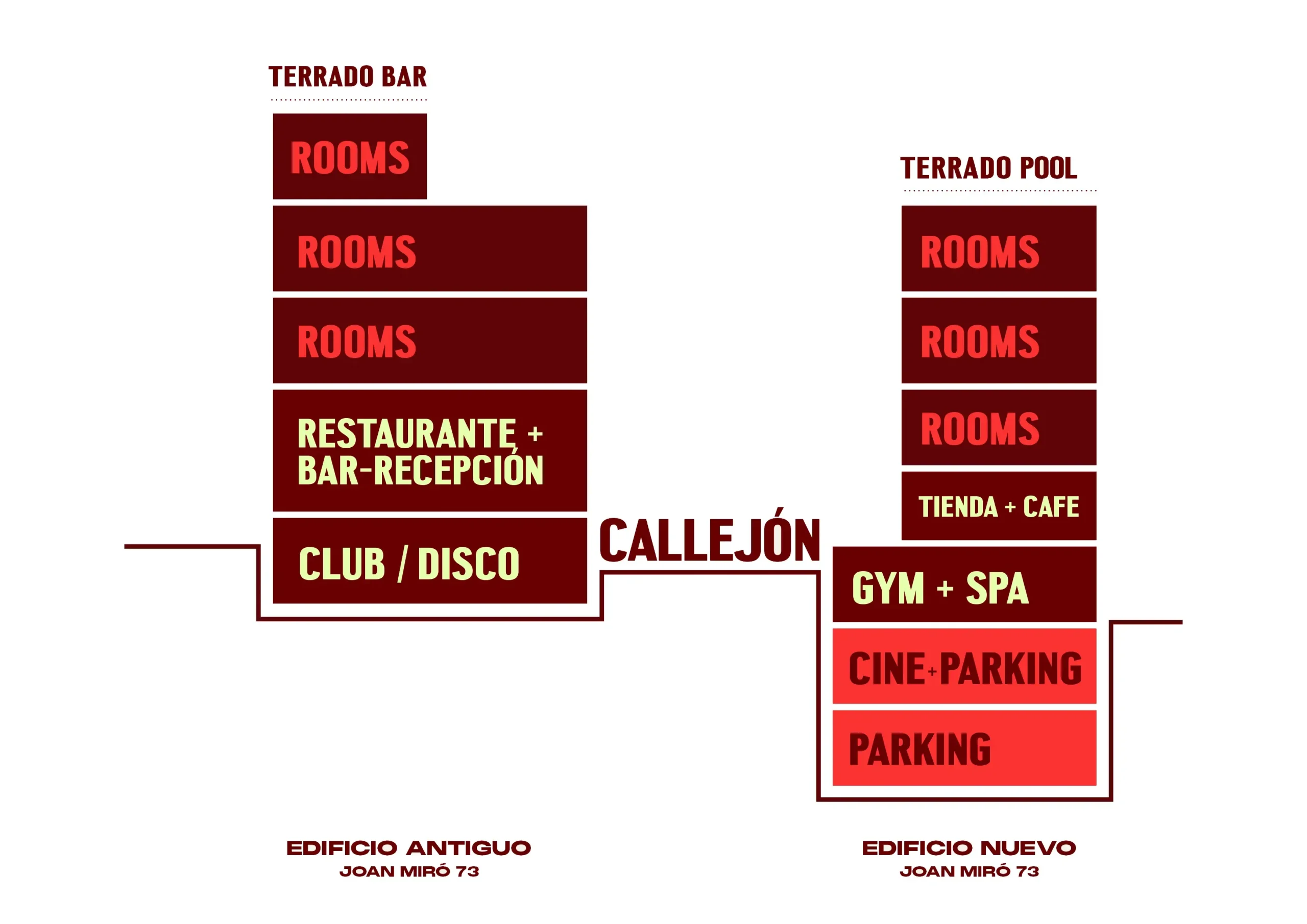
The bazaar: in the new building, the ground floor and the “contact levels” host uses conceived both for guests and for neighbours and external users: café, coworking, take-away, bookshop/gallery, pop-ups, gym, spa and cinema. A bazaar not as a picturesque market, but as a social engine: an exchange of ideas, culture, crafts and everyday rhythms.
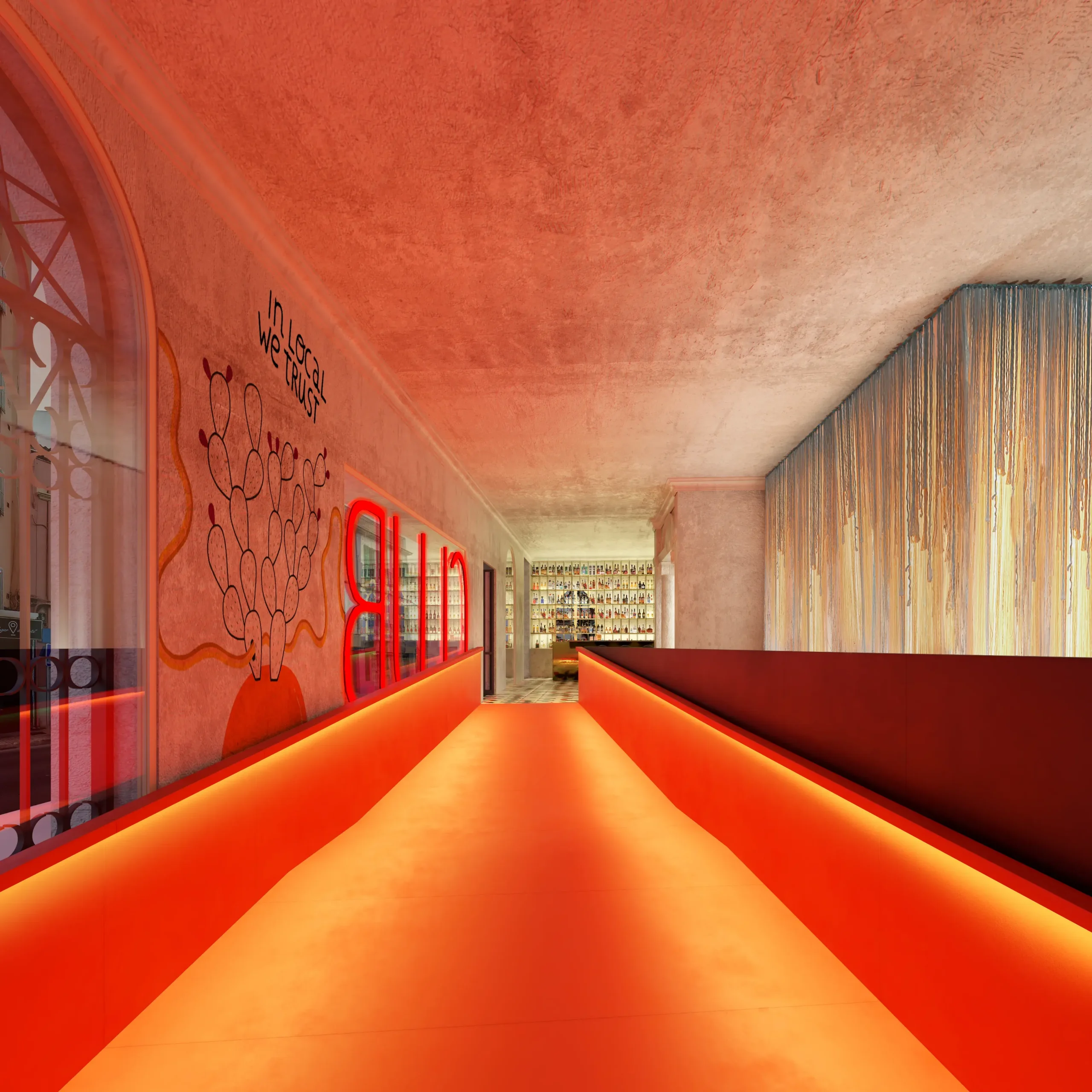
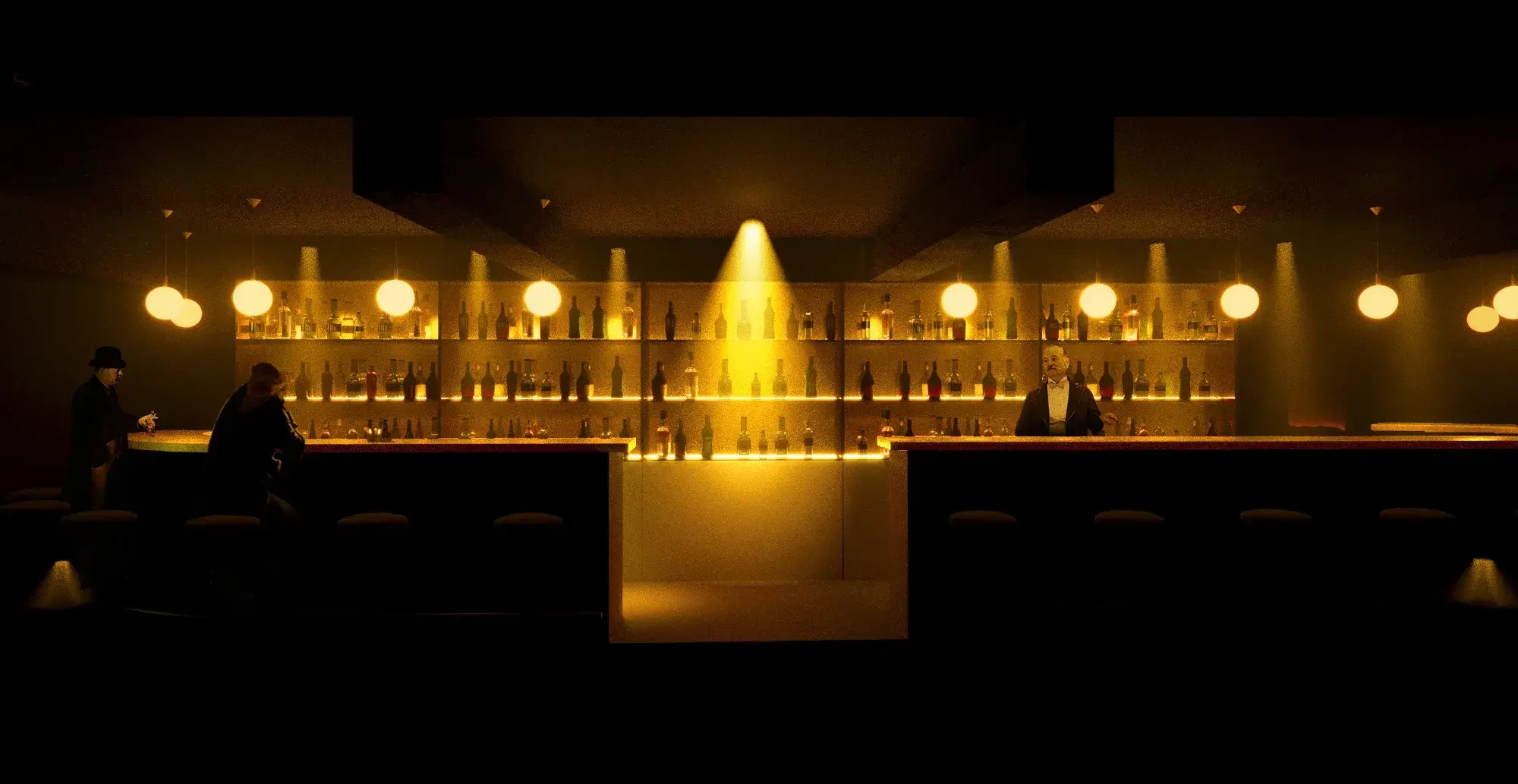
The stage: in the historic building, the ground floor sits one metre above street level. What might be read as a problem—accessibility, lack of “commercial” permeability—becomes a strategy: that level turns the urban frontage into a proscenium. Reception, bar and restaurant form a public interior offered to the city “slightly elevated”, with the logic of seeing and being seen: hospitality as performance.
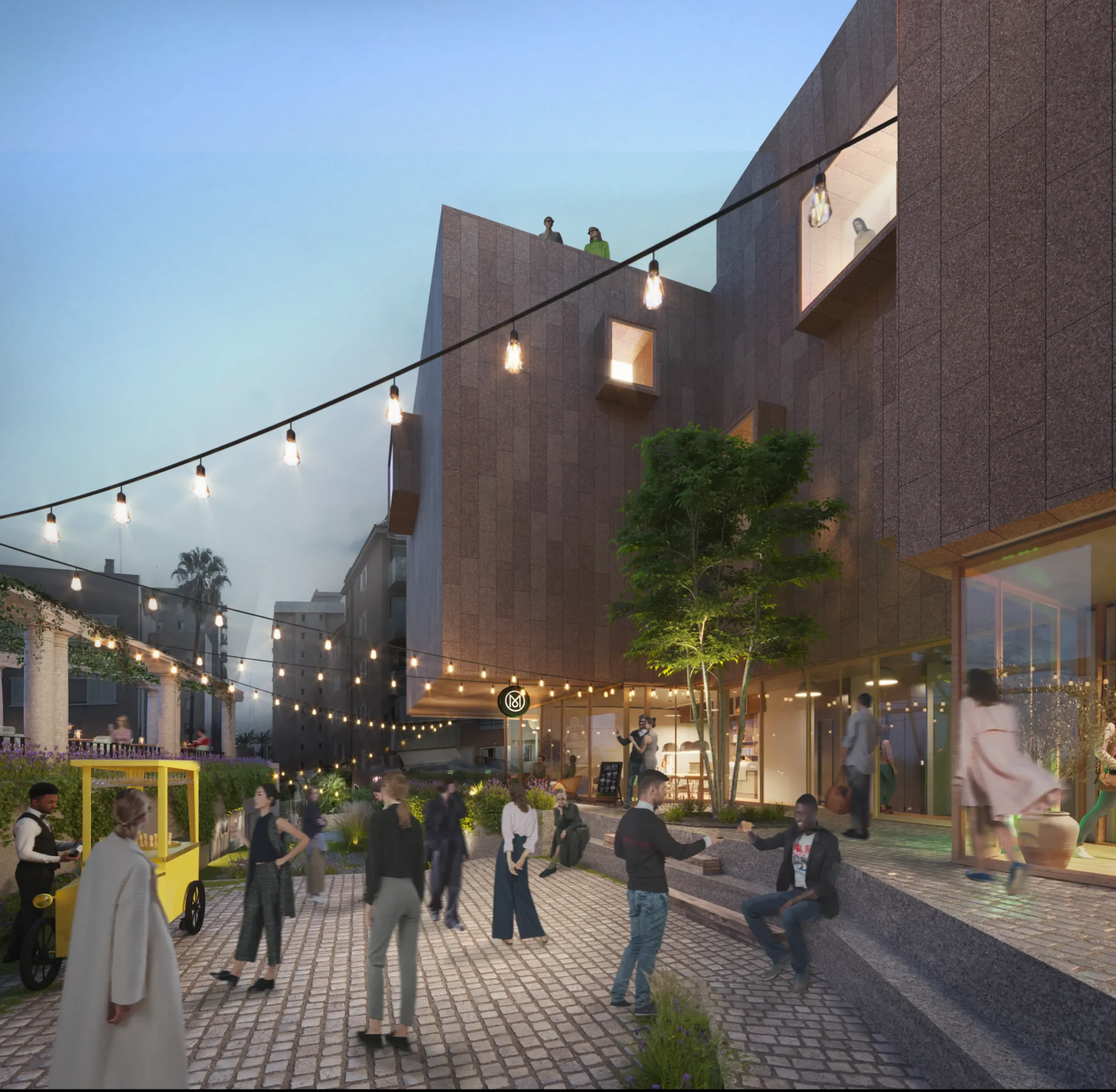
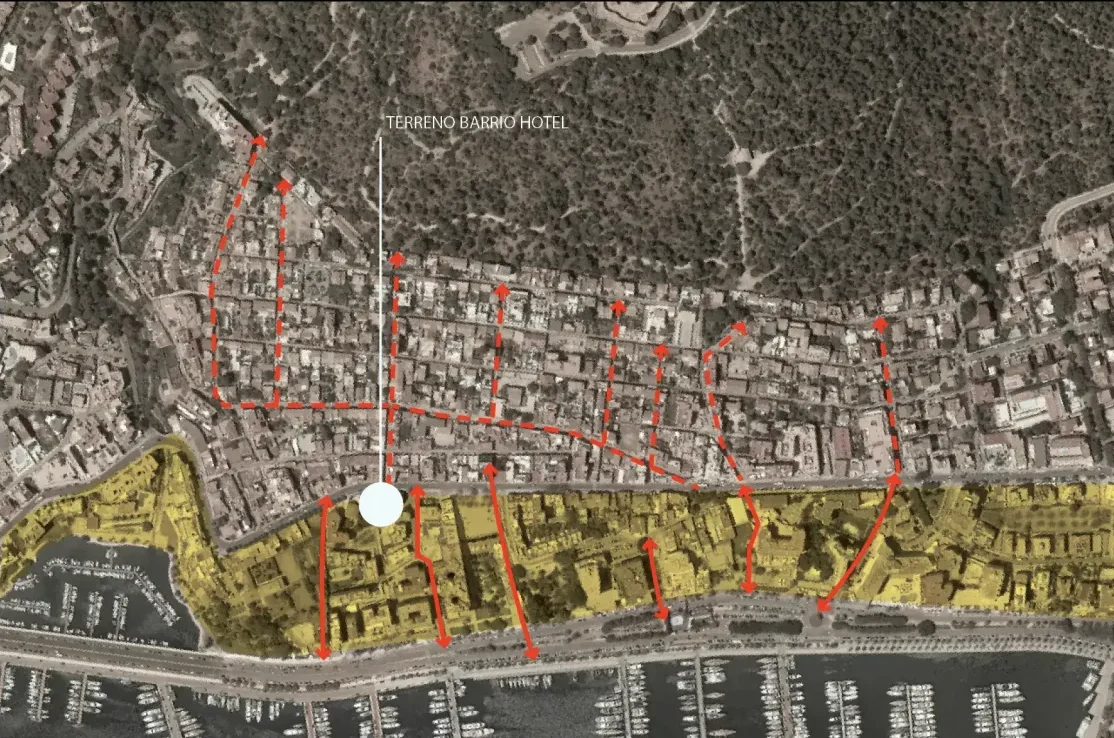
The alley: between the two buildings lies the project’s true centre. This void—private by definition—becomes an open space, a neighbourhood passage where the activities of bazaar and stage spill out, mix and are celebrated. It is also a territorial gesture: the alley works along the neighbourhood–sea direction, strengthening urban permeability beyond the hotel’s perimeter. In Terreno, what matters most is not form, but relationship.
Terreno Barrio Hotel
Palma de Mallorca
Terreno Barrio Hotel
Palma de Mallorca
Four general strategies: preserve, perform, mix, enjoyThe project can be read as the overlap of four strategies—at once conceptual and operational:1. Preserve what exists through a contemporary veil. In the 1935 building, the most direct sustainability is the one that avoids demolition and over-intervention. The strategy is to...
Four general strategies: preserve, perform, mix, enjoy
The project can be read as the overlap of four strategies—at once conceptual and operational: 1. Preserve what exists through a contemporary veil. In the 1935 building, the most direct sustainability is the one that avoids demolition and over-intervention. The strategy is to “do the minimum” structurally, to coexist with consolidated layers (including late-20th-century interventions), and to care for the historic elements that still hold the place’s character. New works remain legible: no pastiche, no falsifying what never existed; a new historical layer, honest and explicit. 2. The hotel as stage. The elevated ground floor is interpreted as a theatrical device. The project embraces—without apology—that hospitality is also representation: a threshold that activates the body, a space where movement becomes a sign. For this reason, everything related to circulation and action is coded in red: the access ramp as carpet, main stairs, the lift cabin, bar stools, the club’s stage, and the mobile trolley for desserts and liqueurs. Movement here means spectacle: divas, fire, performance. 3. The hotel as bazaar. The new building expands the neighbourhood’s urban repertoire with a set of “non-hotel” programmes that generate stable daily life: working, training, reading, drinking coffee, buying a piece, attending a session, stepping back out. The hotel stops being an end in itself and becomes infrastructure. 4. Sustainability as daily delight. Terreno refuses to treat ecology and pleasure as opposites. Sustainability is understood as a precondition for comfort and as a material culture: “the most sustainable energy is the energy you do not consume.” The aim is to be rigorous in performance while remaining desirable in experience: a building that reduces demand and improves life.
Construction site1/9
Construction site2/9
Construction site3/9
Construction site4/9
Construction site5/9
Construction site6/9
Construction site7/9
Construction site8/9
Construction site9/9
Environmental and construction strategy: demand first, carbon nextThe new building follows Passive House logic (even if not certified): a target energy demand below 14 kWh/m²·a, and an envelope engineered with precision. The façade of vertical timber louvers opens and closes via home automation to optimise solar gain—admitting sun...
Environmental and construction strategy: demand first, carbon next
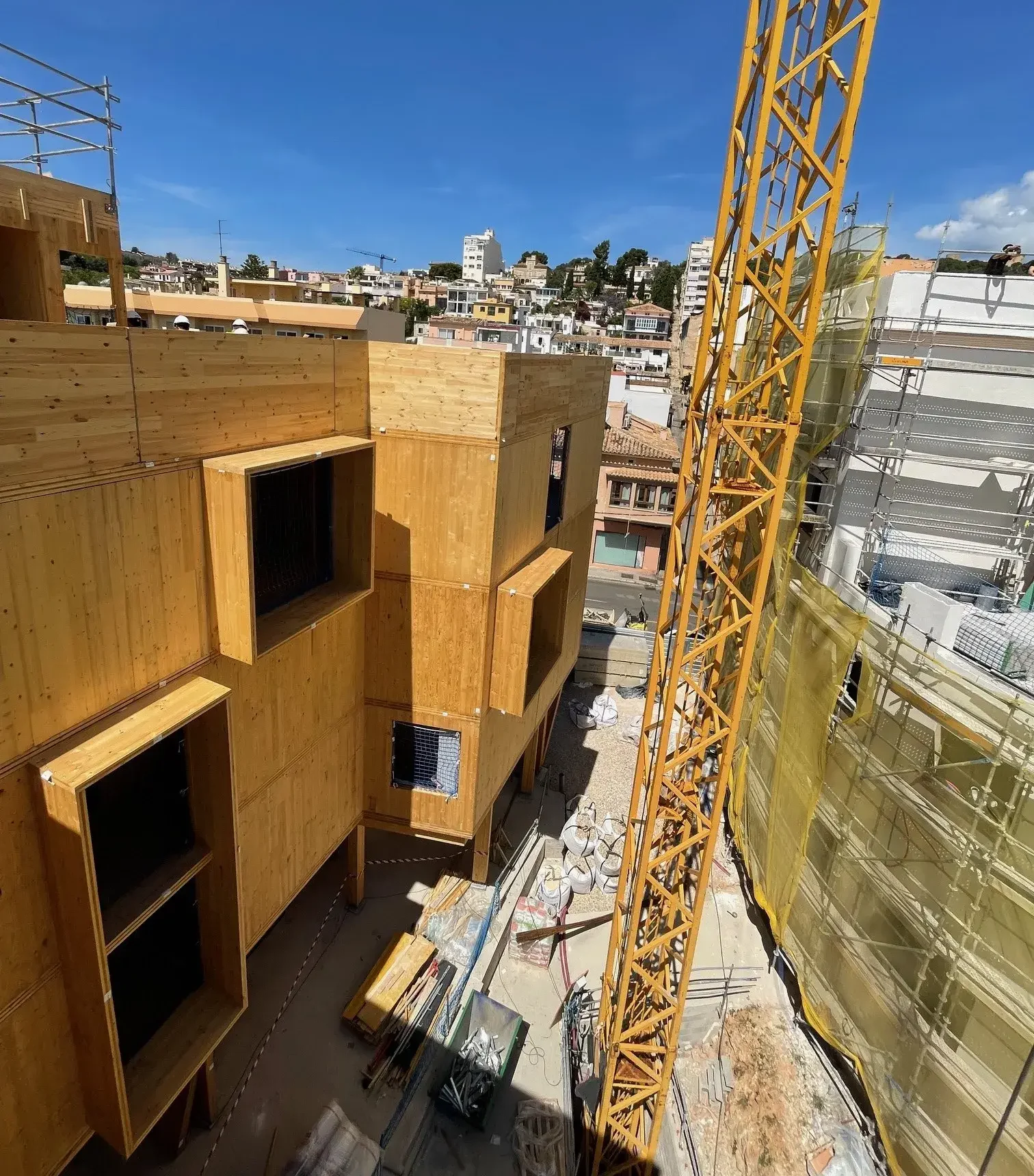
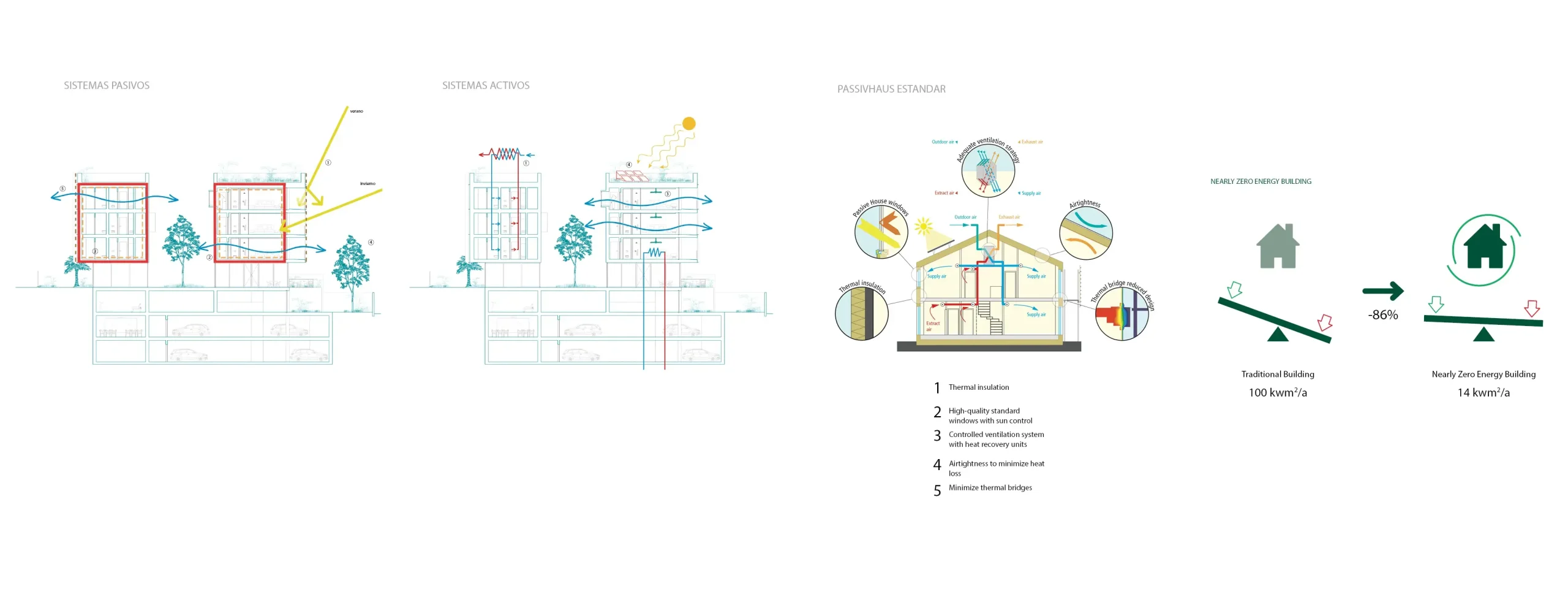
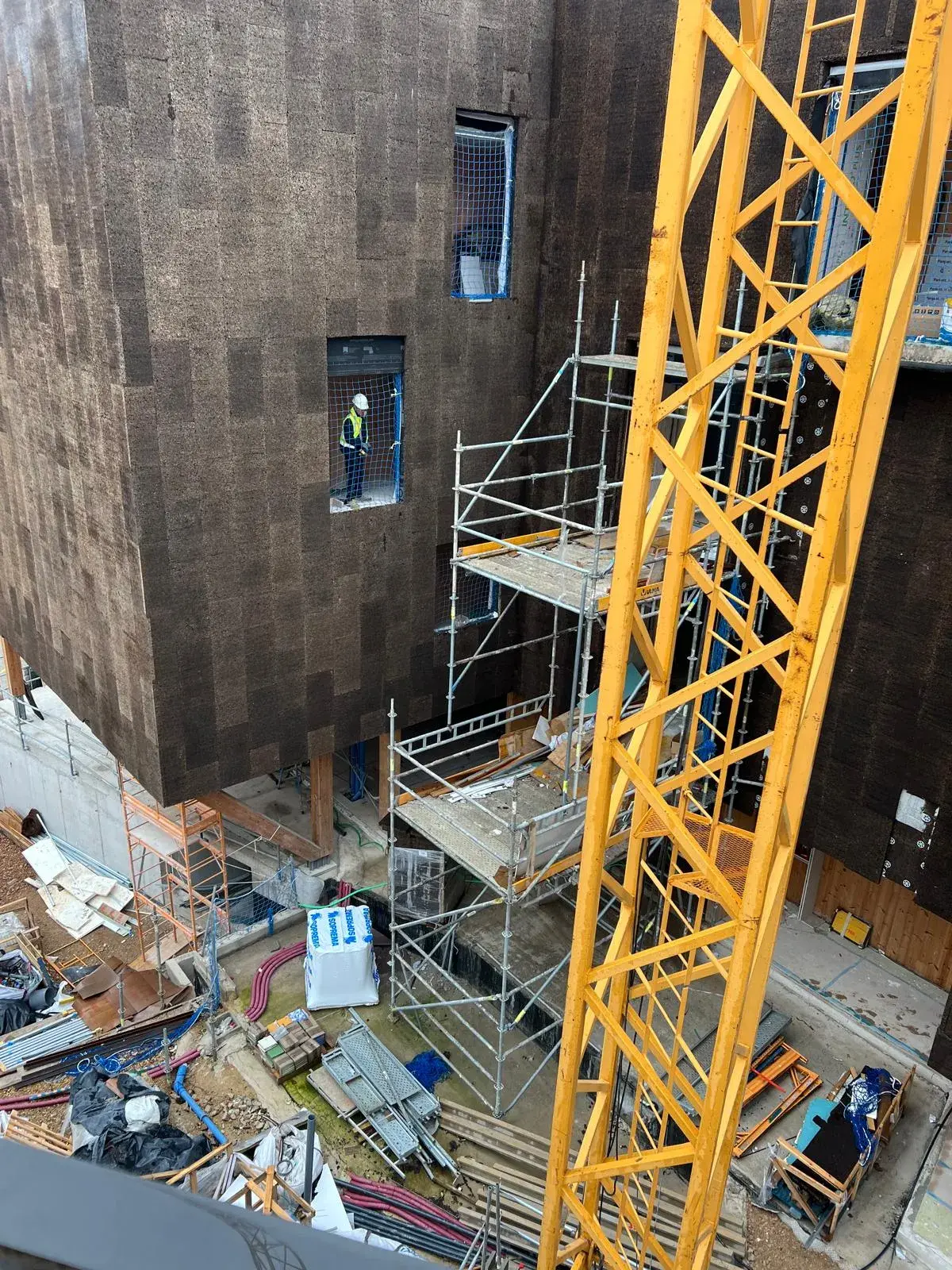
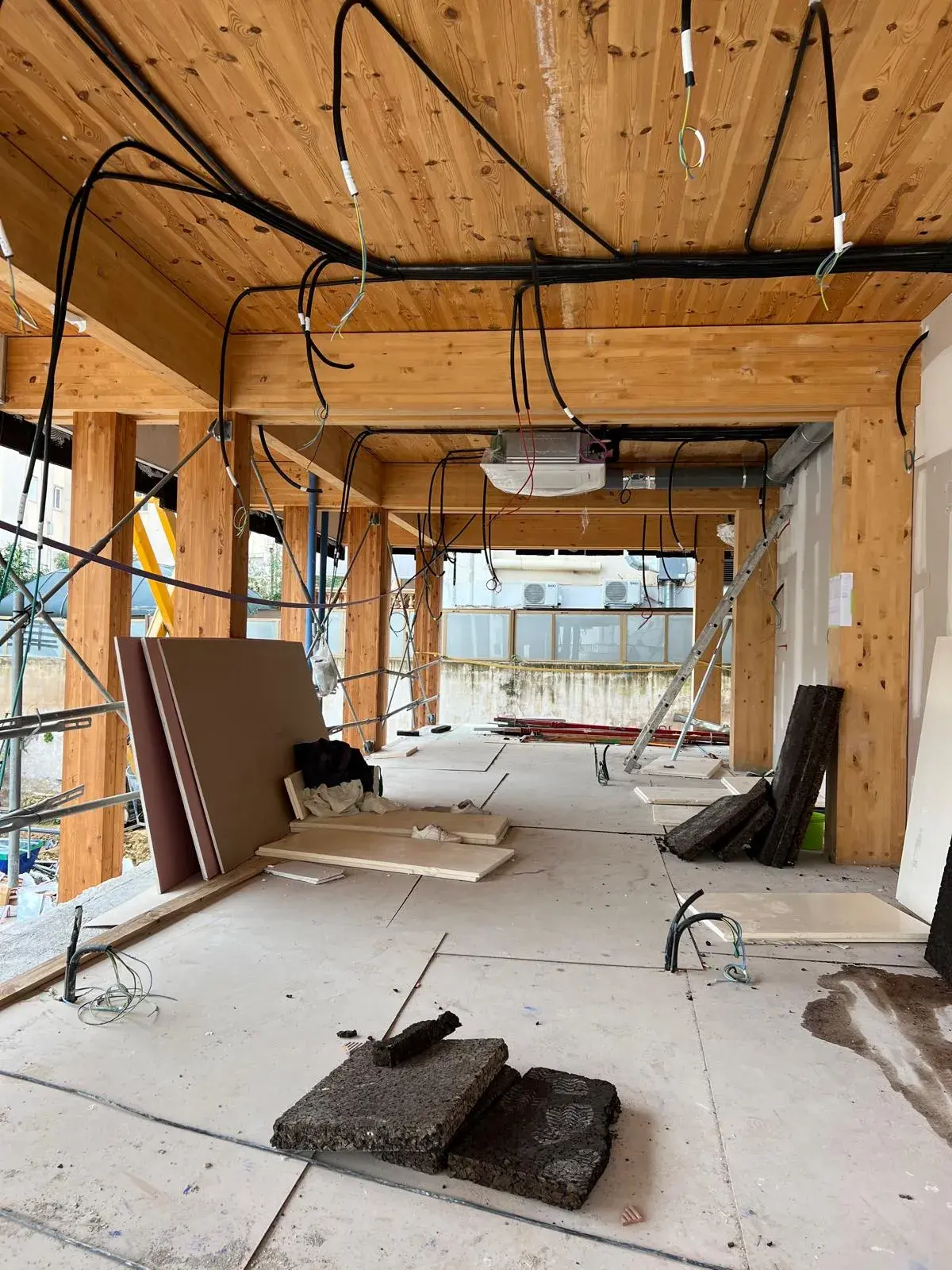
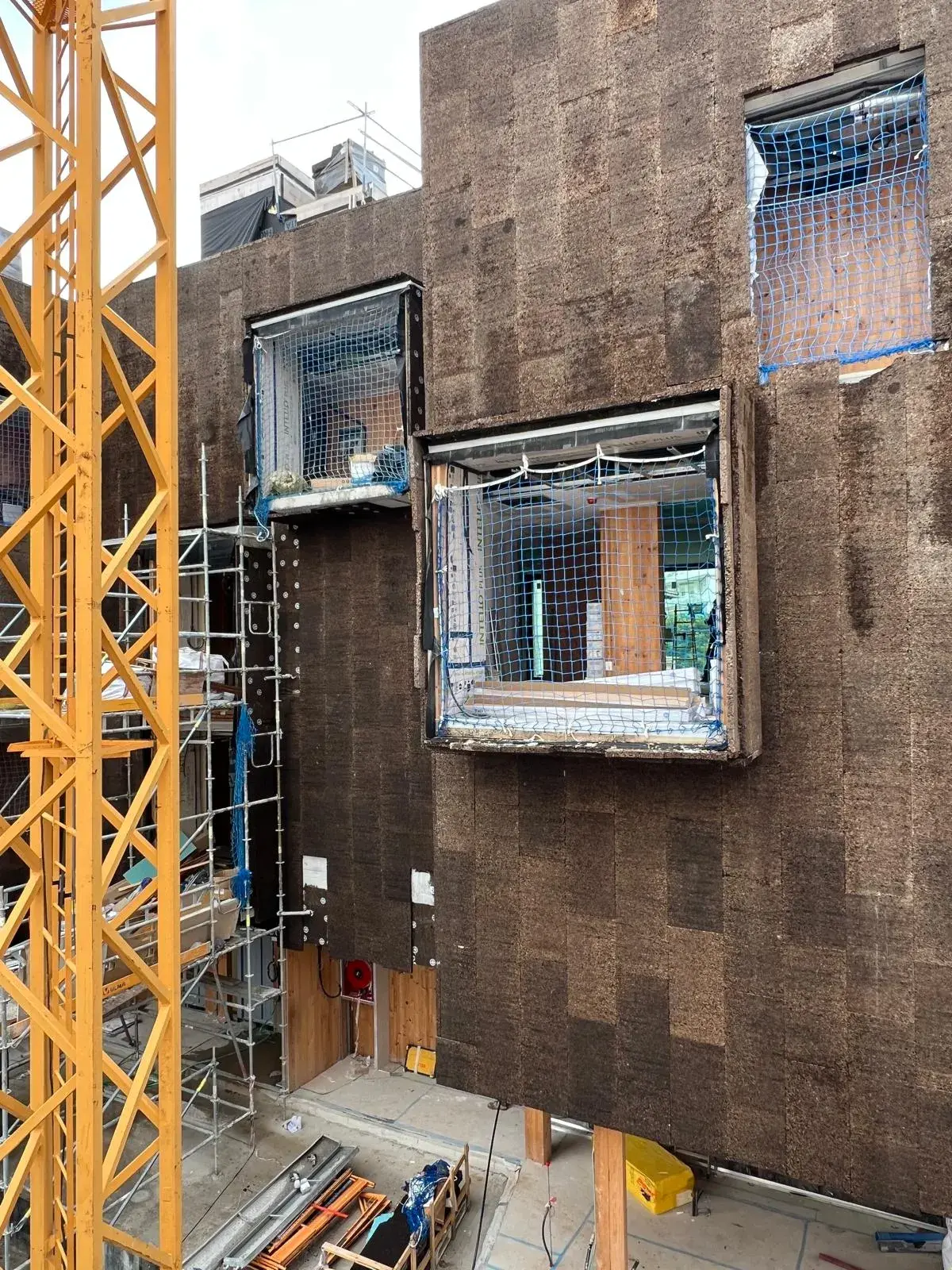
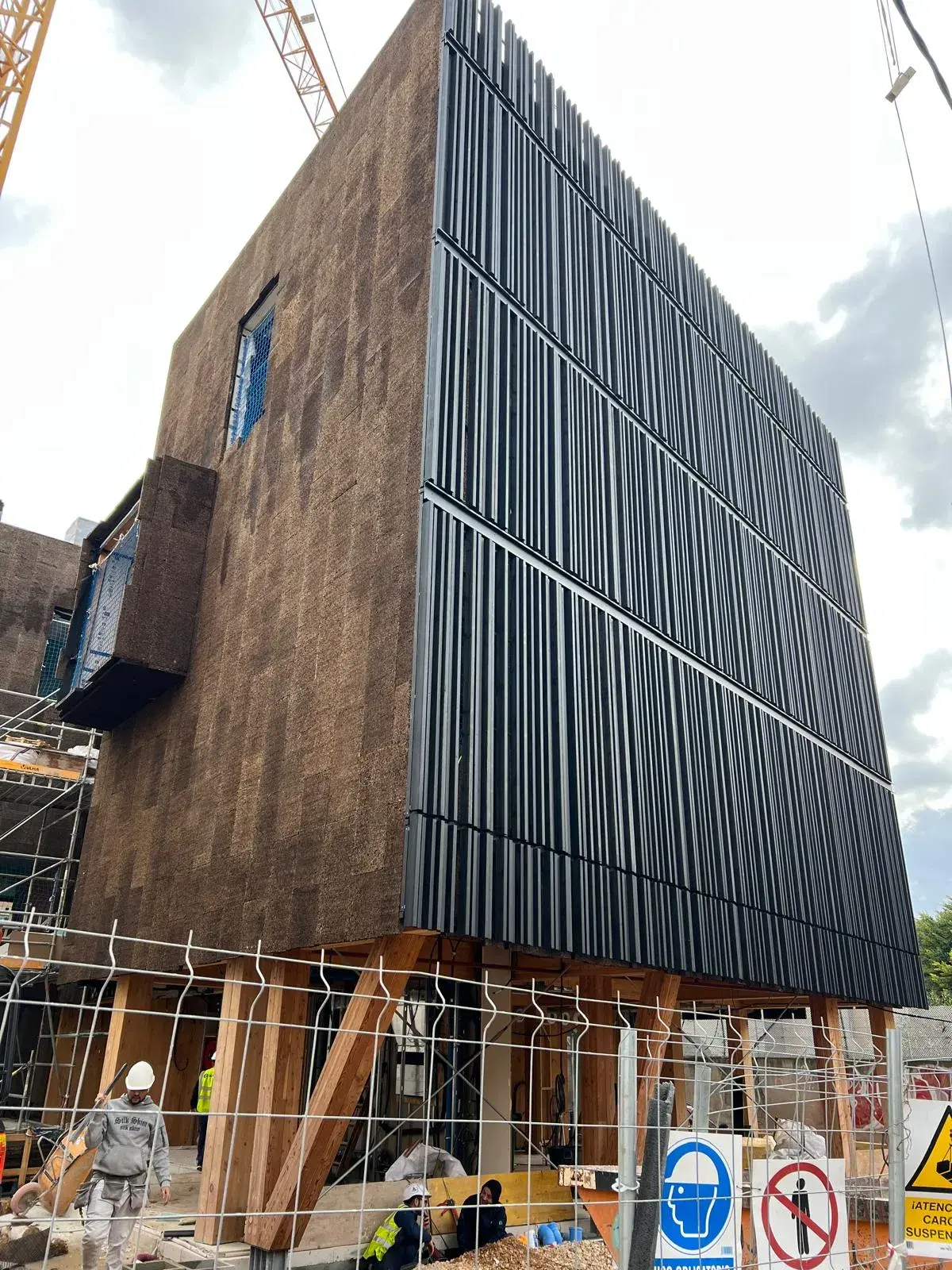
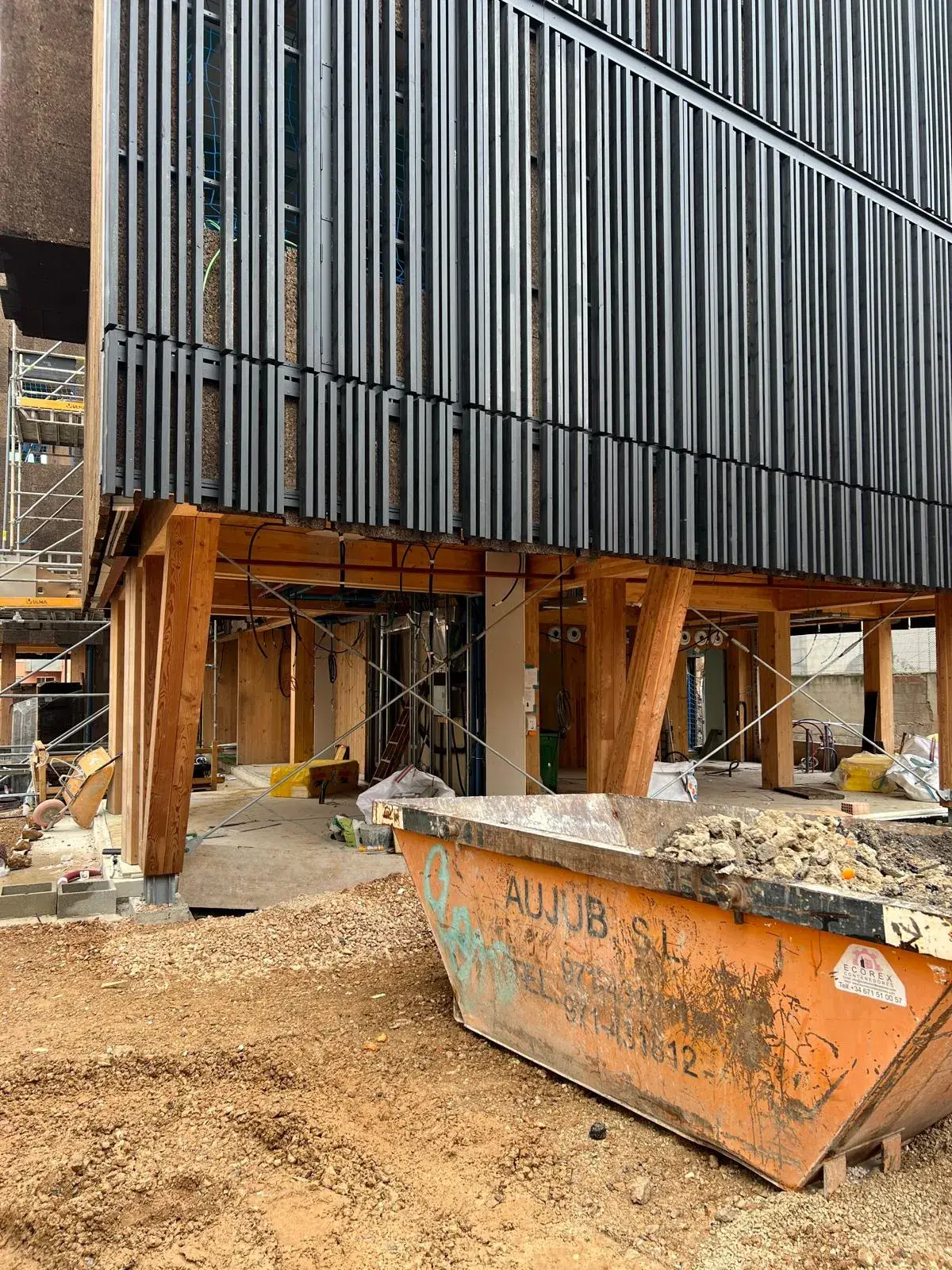
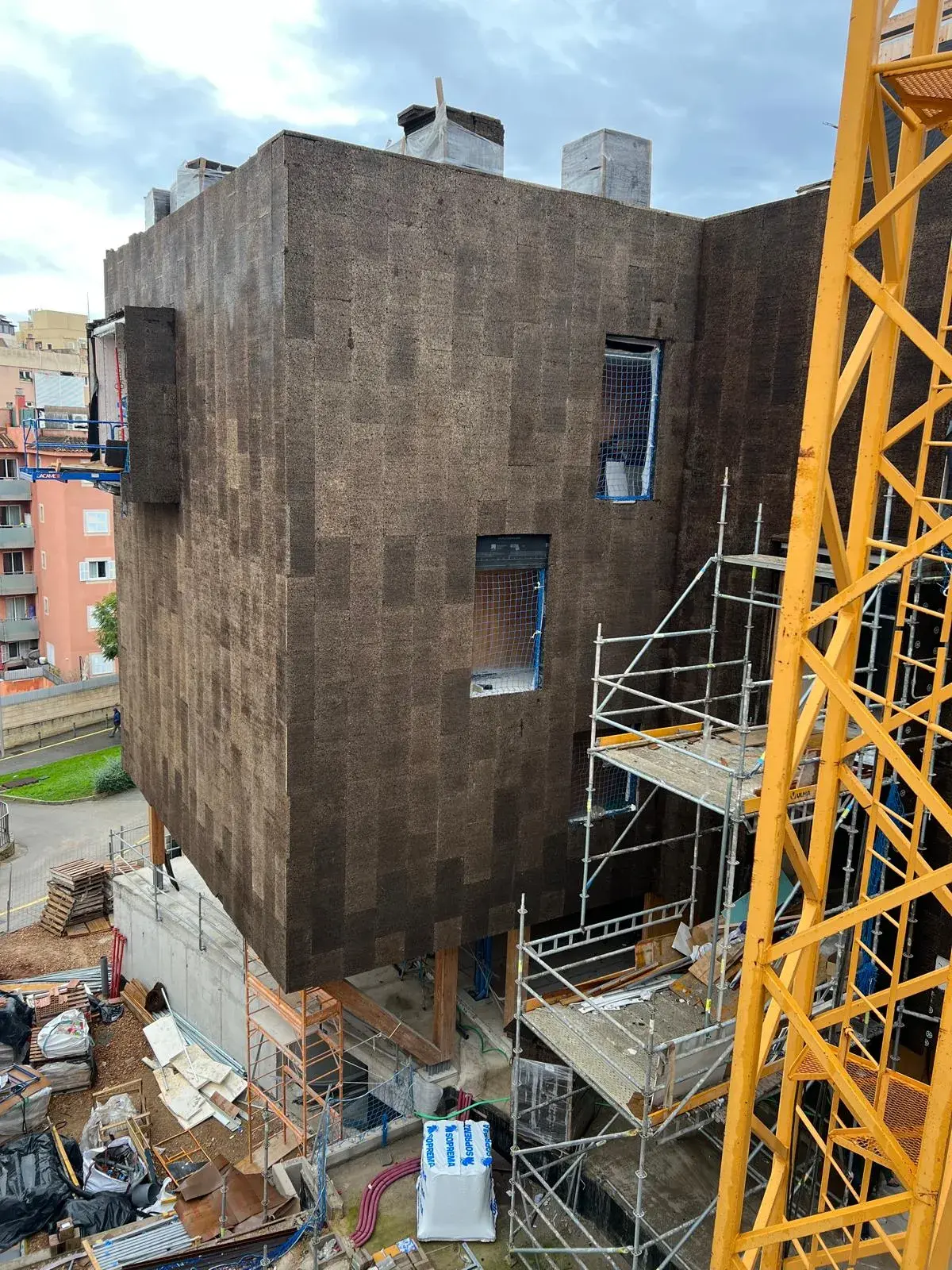
The new building follows Passive House logic (even if not certified): a target energy demand below 14 kWh/m²·a, and an envelope engineered with precision. The façade of vertical timber louvers opens and closes via home automation to optimise solar gain—admitting sun in winter and blocking it in summer. The certified wood is protected with a dark stain (lasur) (not charred): not as an aesthetic gesture, but as a decision for durability, breathability and layered maintenance, enabling real repairability and more stable ageing—aligned with the project’s broader sustainability ambition. On the north façade, insulation is shown without disguise: natural cork is revealed as a climatic material.
The CLT structure is more than a “green material”: it shifts the construction regime—precision, speed, reduced embodied footprint—and generates an interior atmosphere that relocates the idea of luxury from shine to environmental quality.
Circularity and craft culture: Mallorca as a complete chain
Circularity is made concrete. Part of the materials from the demolition of the existing building are recovered and transformed. A key cycle is the new terrazzo elements—floors, basins and showers—produced in Campos with Huguet using material from the demolition itself: the building reappears within itself, rewritten.
In parallel, furniture is treated as an architectural chapter: OHLAB-designed and locally produced, a deliberate effort to activate a network of Mallorcan artisans and designers—from established brands to emerging workshops—so the project does not “import” identity, but manufactures it through matter, craft and Mallorca’s creative ecosystem.
Two room typologies: two ways of inhabiting historical layers
The rooms are not homogenised. Each building proposes a distinct spatial logic.
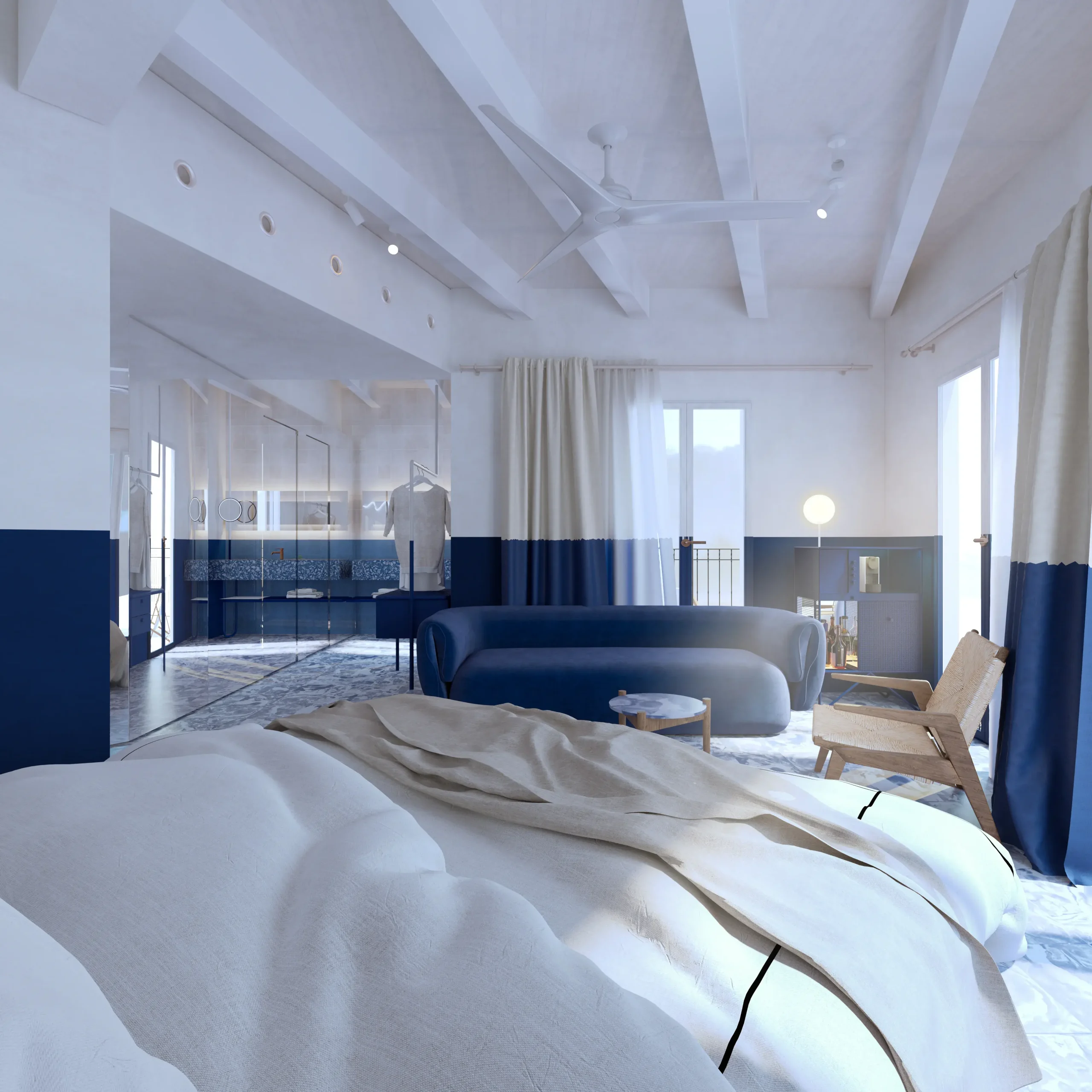
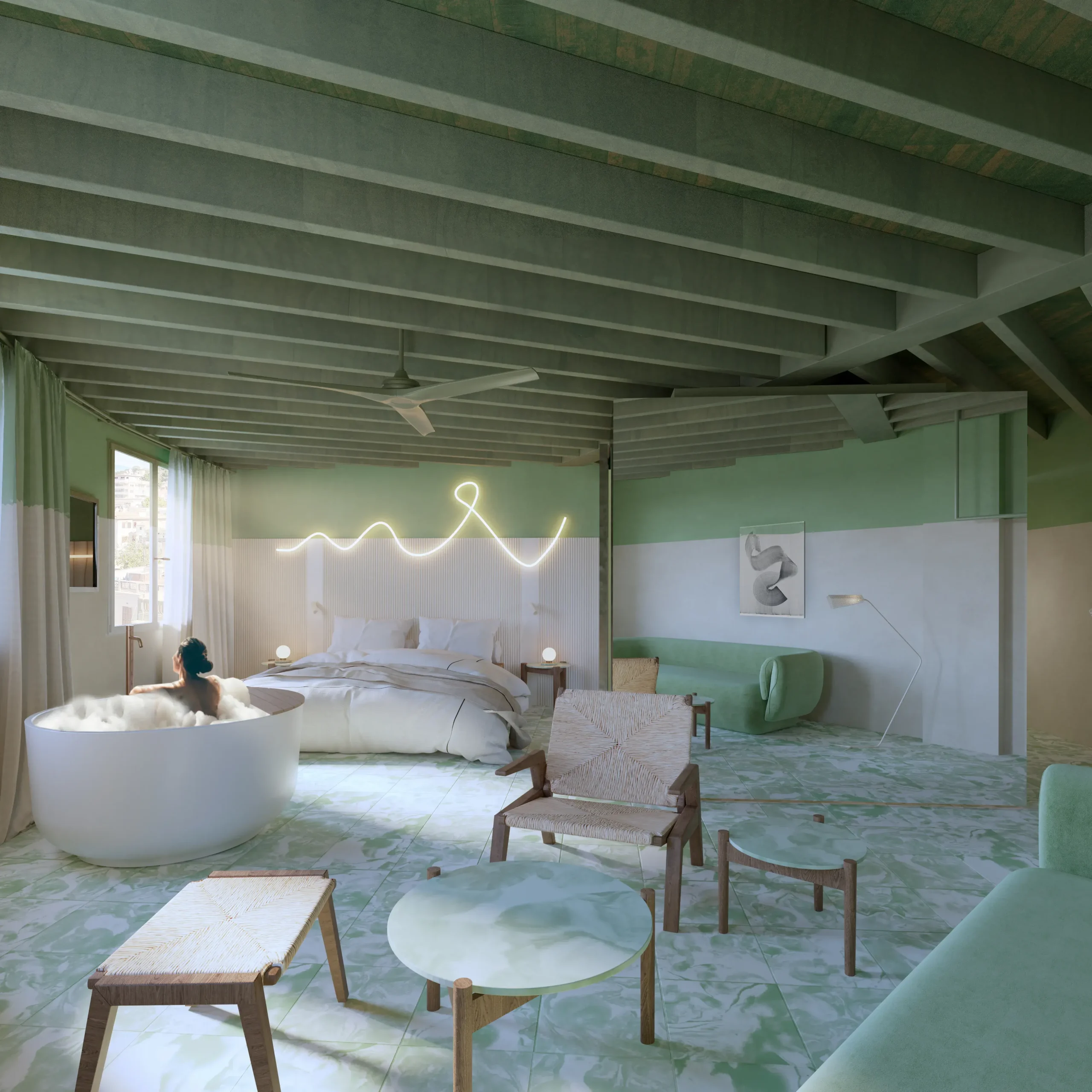
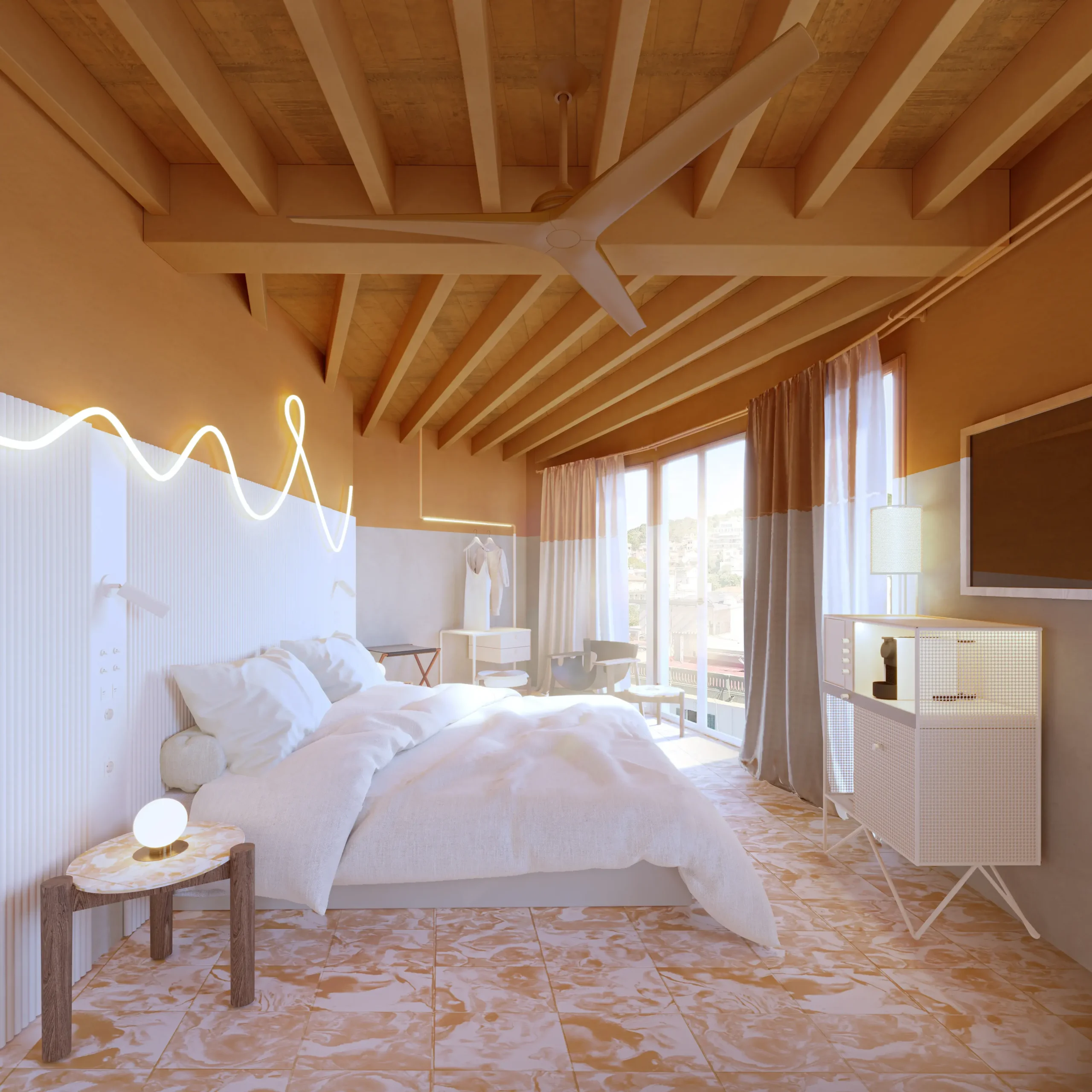
In the historic building, the room is organised by a horizontal line separating two worlds: above, what is found; below, a new chromatic layer that floods every detail. Between both, a neon tube—drawn by Mallorcan artist Pedro Óliver—stitches old and new together. Each room also includes an oil painting: a collection of single-stroke brush gestures that build volume and correspondences of light with the neon.
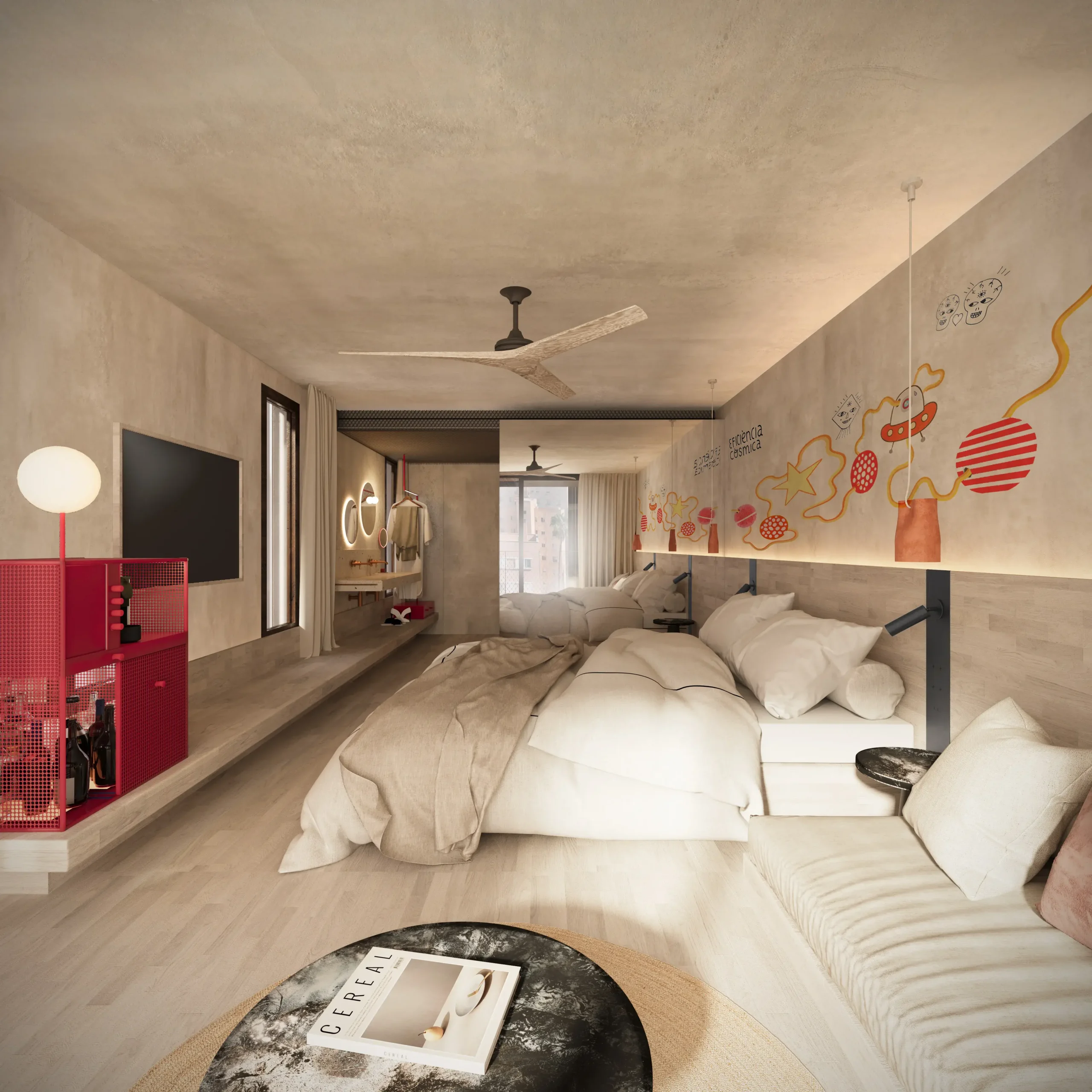
In the new building, Mallorcan artist Albert Pinya enters each room with a mural/graffiti: a universe of characters that, with almost pop optimism, reflects on energy efficiency, local resources and carbon footprint. Here, the timber floor folds to form a headboard and sofa back; bathrooms become one-way mirrored boxes that allow views towards the balcony from the shower; the space turns into a small domestic scene where technique and narrative coexist without solemnity.
Architecture and Interior Design: OHLAB / oliver hernaiz architecture lab
Team OHLAB: Paloma Hernáiz y Jaime Oliver con Robin Harloff, Juan Carlos Martínez, Carlos Garijo, Lara Ortega, Maria Bruna Pisciotta, Sonia Hernan, María Dominguez, Bárbara Beltrán, Elisa Lazzarotto, Pablo Sinan, Loreto Angulo, Marta Carvalho, Wiktoria Krapiec, Camila Ospina, Laura Barros, Sofía Galdame, Maja Stankowska, Mateusz Baranowski, Natalie Battah, Thea Schütz, Zheng Xiagyuan, Izabella Warcaba, Eirini Papadatou, Katerina Rangelova.
Building services engineering: Ingenio Consultores
Structural calculation: HIMA Consultores de Estructuras
Consultant Passivhaus: Plus Aurea. Architecture & Engineering
Consultant LEED: PGI Engineering and Consulting
Acoustic engineering: Acústics Ambient SL Consultoria Acústica Insonorización and Tarfortecht
Audiovisual consultant: INTRVL AV
Landscape: Verdsatile
Construction Director: Jorge Ramón Monegal
Health and Safety Coordination: Seguridad y Salud Balear
Construction company: UTE de Tarraco y Pycocsa
Installation company: Sampol
Wooden structure: Egoin Wood Group S.A.
Wooden lattice: Durmi
Exterior joinery: Carpintería Palmer
Interior joinery: Diho Contract
Transport: Schindler